

Your Team Is Your Mirror | How Leaders Create Subcultures Through Their People
In some organizations, culture is not experienced uniformly. While strong leadership at the top can create consistency across departments, inconsistencies in leadership enforcement often give rise to subcultures. You can move through the same organization and encounter vastly different behaviors, standards, and expectations depending on who is leading a particular team. That difference is not accidental. It is leadership. While organizations may promote shared values from the top, employees experience culture most directly through their immediate leaders. This is where standards are either upheld or diluted. Over time, a leader’s conduct, discipline, and integrity form a recognizable pattern that becomes the identity of their team.

A Maintained Environment Is Proof of a Maintained Standard
A well maintained environment is one of the clearest reflections of leadership because it reveals what you prioritize long before you ever speak a word. Maintenance is one of the most overlooked indicators of strategy, discipline, and long term success. It is also one of the easiest areas to assess when determining whether a business or organization is committed to excellence or simply coasting. Far too many companies wait until things are visibly crumbling, declining, or outright broken before addressing issues that could have been managed with minimal effort and far less cost. Leaders must understand that consistency in maintenance is not cosmetic. It is foundational. Yes, budgets can be tight. Many leaders know what it feels like to stretch every dollar. Yet even in those moments, intentionality matters. Making a conscious and concerted effort to protect your standards speaks volumes about how you value the people you serve. If a piece of wood is chipping, clean up the chipped area, seal it, repair it, and preserve it before the entire panel breaks. Do not wait until it becomes an expensive project when it could have been a small fix.

When Everyone Makes Their Own Rules, No One Wins
Every strong organization understands that structure is not about creating a militant environment. It is about creating a foundation that protects the mission, the people, and the standards that allow excellence to thrive. When there are no clear rules, and when leaders do not enforce them with consistency, the environment begins to slide into something subtle yet dangerous. A free for all. And a free for all slowly turns into chaos, misalignment, inconsistency in output, and individuals creating their own rules that are not always in the best interest of the organization or the people being served. One of the clearest real world parallels is found in communities with strong Homeowners Associations. Some of the best HOAs understand that their rules were never designed to restrict residents. They were designed to protect the comfort, safety, and quality of the community by maintaining a shared standard. In contrast, when a community has no HOA or has one with weak enforcement, everything becomes subjective. One neighbor may decide they no longer want to trim their lawn. Another may choose to store junk outside of their home. Another may paint their house a color that completely disrupts the look and feel of the neighborhood.
Leadership Beyond Buzzwords
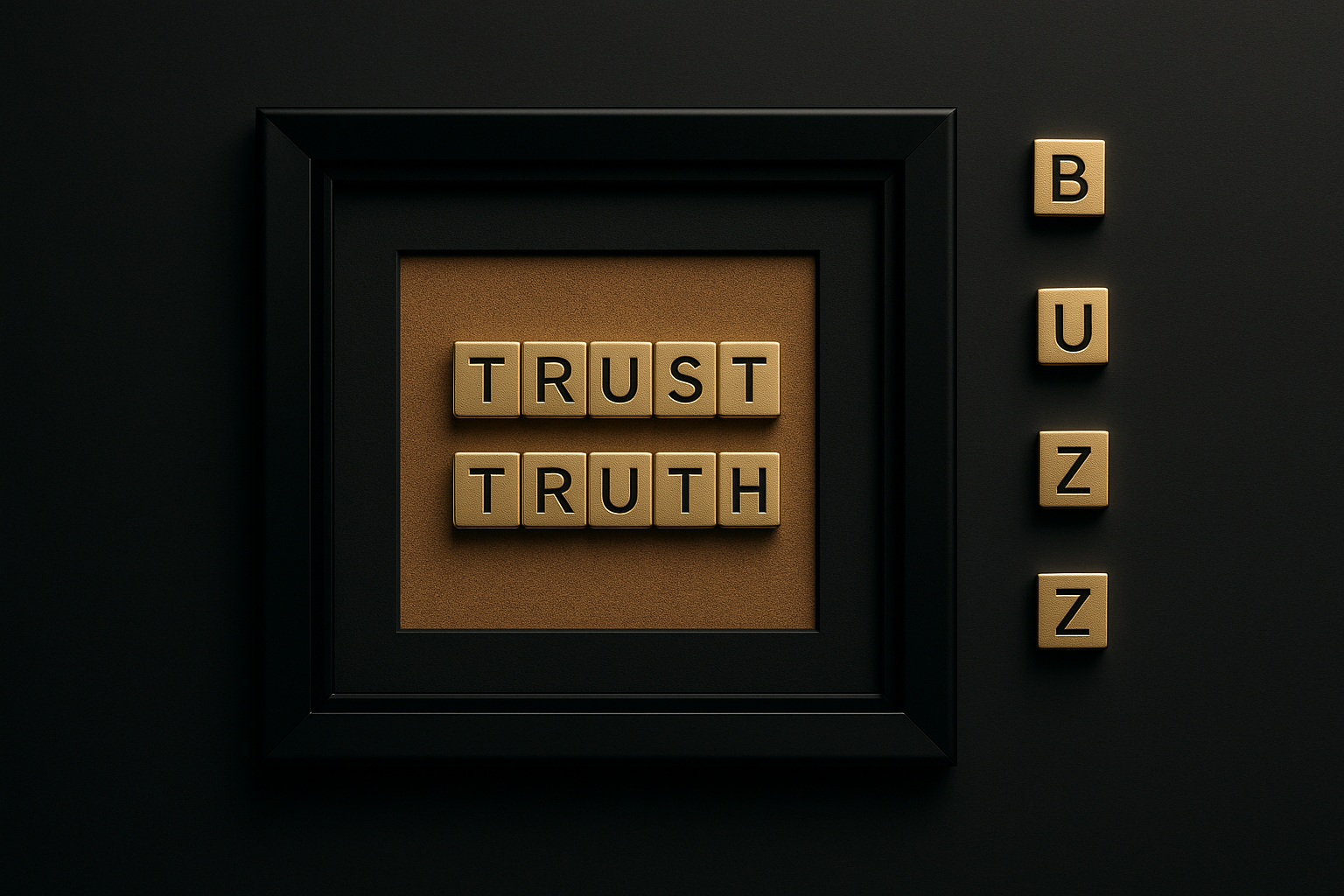
A quiet but undeniable awareness is growing across workplaces, showing that words alone are no longer enough. Leaders can no longer rely on impressive language or well rehearsed statements to demonstrate commitment. Employees, stakeholders, and partners want action, consistency, and delivery. Recent global data shows that workers increasingly expect transparent communication and follow through from their leaders, not polished rhetoric (Edelman, 2024). Buzzwords are also losing their influence. The carefully curated phrases that once sounded impressive are becoming meaningless. People can sense when language is overly polished or engineered to create an image rather than express the truth. Many employees are now preferring communication that is clear, direct, grounded, and free of unnecessary jargon. They want raw truth instead of rehearsed terminology. Recent insights confirm that authenticity is becoming one of the most valued leadership traits across the workforce (McKinsey & Company, 2023).

Leadership Lessons from Gordon Ramsay’s “Method: Knife Skills”
In Gordon Ramsay’s MasterClass, there is a session titled “Method: Knife Skills.” It is simple, technical, and surprisingly profound. In this lesson, he explains how to sharpen your knife, how to hold it, how to move with precision, and most importantly, how to select the right tool for the right purpose. A chef does not randomly swing a blade. Every cut has intention. Every knife has a role. Every movement reflects training, discipline, and awareness. This is not just culinary instruction. It is leadership instruction. The same mindset that produces excellence in Ramsay’s kitchen is the mindset that produces excellence in leadership. In “Method: Knife Skills,” Ramsay breaks down the purpose of each knife. A chef’s knife is versatile and powerful, but there are moments when only a paring knife will give the finesse required. A boning knife bends for a reason. A serrated knife moves differently. Mastery is not only knowing what the tools are but understanding the nuance of when to use them.